

LOOKFORBOB.COM · BLACK BUSINESS NEWS & ADVOCACY
BLACK ENTREPRENEURSHIP · RESTAURANT INDUSTRY · CAPITAL & GROWTH
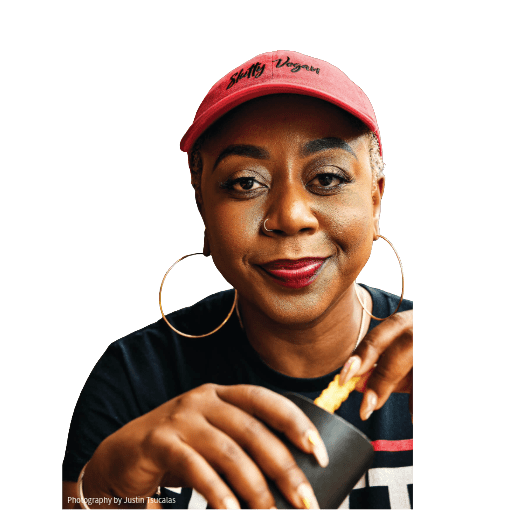
Pinky Cole built one of the most celebrated Black-owned restaurant brands in American history. The same ambition that took her to $100 million is now at the center of a federal bankruptcy filing. The real story is more complicated — and more instructive — than either the celebration or the collapse.
Published: March 3, 2026 · LookForBOB Editorial Team
— THE ORIGIN: A GHOST KITCHEN AND A DREAM
In 2018, Aisha ‘Pinky’ Cole was working out of a shared commercial kitchen in Atlanta, filling vegan burger orders she had taken through Instagram. She invested $10,000 in a food truck. Within weeks, lines were forming. Within a year, she had a brick-and-mortar location. Within three years, she had one of the most talked-about restaurant brands in America.
Slutty Vegan wasn’t supposed to work the way it did. The vegan restaurant industry had long been written off as too niche, too coastal, too far from the cultural center of gravity of Black food. Cole — daughter of Jamaican immigrants, a Baltimore native who graduated from Clark Atlanta University — decided that assumption was wrong. She named the burgers things like the Sloppy Toppy, the Hollywood Hooker, and the Fussy Hussy. She described the concept as ‘a merge between the two most pleasurable experiences in life: sex and food.’ She made plant-based eating feel like a party.
By 2021, Slutty Vegan had multiple Atlanta locations and an estimated $10 to $14 million in annual revenue, according to CNBC. The waiting list for a table was a social media event in itself. Cole had done something genuinely rare: she built a brand that Black consumers loved deeply, that mainstream food media couldn’t stop writing about, and that positioned itself at the exact intersection of culture, health, and community that the next generation of Black consumers was moving toward.
| “I always wanted to build a billion-dollar brand.” — Pinky Cole, Forbes, 2022 |
— THE ASCENT: $25 MILLION, A $100M VALUATION, AND 14 LOCATIONS
In 2022, Cole raised $25 million in a Series A funding round that valued Slutty Vegan at $100 million. The lead investors were Richelieu Dennis’s New Voices Fund — specifically designed to back women of color entrepreneurs — and Danny Meyer’s Enlightened Hospitality Investments, the firm behind Shake Shack. Having Danny Meyer, arguably the most respected operator in American restaurant history, put money behind Slutty Vegan was not just a capital event. It was a signal to the entire industry.
With the capital, Cole announced plans to open 10 new locations by the end of 2022 and another 10 in 2023. At peak expansion, Slutty Vegan had 14 branded locations across Atlanta, Birmingham, Brooklyn, Baltimore, and beyond — plus a presence at Hartsfield-Jackson Atlanta International Airport and Spelman College. Each new store cost approximately $875,000 to build. Cole was doing this construction during the pandemic and post-pandemic inflation, when supply chains were fractured and everything cost more.
Alongside the restaurants, she built an ecosystem: a cookbook (Eat Plants, B*tch, nominated for an NAACP Literary Award), a product line at Target (Slutty Strips vegan bacon, Pinky’s Dips), a shoe collaboration with Steve Madden, and CBD gummies. The Pinky Cole Foundation paid student tuition, gifted LLCs to graduating college students, and partnered with Operation HOPE and One Million Black Businesses. At Savannah State University’s 2024 commencement, she delivered what she called an ‘$8.75 million Entrepreneurial Starter Pack’ to the graduating class.
At the same time, Cole secured SBA loans under the COVID-19 Economic Injury Disaster Loan (EIDL) program — federal capital designed to help small businesses survive the pandemic’s revenue losses. These were not grants. They were loans, and they would eventually become the largest single line item in her bankruptcy filing.
— THE BREAKING POINT: $10 MILLION IN OVERHEAD AND A COMPANY UP FOR AUCTION
In April 2025, Cole sat down with the Earn Your Leisure team and pulled back the curtain on what had gone wrong. The summary: Slutty Vegan had generated $70 million in lifetime revenue. The business had not failed for lack of customers or culture. It had failed under the weight of its own scale.
| “Our corporate overhead was about $10 million. I was chasing something that I couldn’t catch for so many reasons.” — Pinky Cole, Earn Your Leisure, April 2025 |
The $10 million annual overhead figure — which included staffing, operations, and the costs of running 14 locations simultaneously during an inflationary period — had grown faster than the revenue could support. Locations like the Bleecker Street outpost in New York closed after just months of operation. Others temporarily shuttered amid operational strain. Cole, who described herself as the visionary but not the day-to-day operator, faced what she later described as the harshest lesson of her entrepreneurial life: ‘You can never take your hands off the wheel.’
On February 13, 2025, Slutty Vegan underwent a state-level restructuring — an Assignment for the Benefit of Creditors (ABC), a formal Georgia process that places a company’s assets under third-party management to satisfy debts. Cole legally lost ownership of the company she built. For 43 days, she watched from the outside. ‘It was like watching a house you built go up for auction,’ she said.
On March 28, 2025, Cole bought the company back — under the parent name ‘Ain’t Nobody Coming to See You, Otis LLC,’ a reference to the 1998 Temptations film. She retained approximately 85% ownership. But the chain had contracted from 14 locations to six. Planned expansions were halted. The brand was alive, but diminished.
— CHAPTER 11: THE FEDERAL FILING AND WHAT IT MEANS
On February 12, 2026, Cole filed for personal Chapter 11 bankruptcy in U.S. Bankruptcy Court in Atlanta. This is a personal filing — not a corporate one — though Cole owns 85% of the restaurant chain. Chapter 11 is a reorganization bankruptcy, not a liquidation. It allows the filer to restructure debts under court supervision while continuing to operate.
The filing reveals the following:
- $1.2 million owed to the U.S. Small Business Administration — the COVID-era EIDL loan
- $192,000 owed to the Georgia Department of Revenue in back state taxes
- An additional $140,000 investment property facing foreclosure
- Unpaid rent lawsuits exceeding $87,000 for two Atlanta locations
- Cole listed herself as “unemployed” in the filing
Her listed assets include $2.8 million in real estate, $435,000 in vehicles (including a bus named ‘The Magic School Slut’), $1 million in restaurant equipment, $15,000 in designer shoes, and a $5,000 French bulldog. Total debts are approximately $1.4 million against total assets that significantly exceed that figure.
A bankruptcy teleconference is scheduled for March 12, 2026. Cole’s reorganization plan is due June 12, 2026. It is important to note: Chapter 11 is not an ending. It is a court-supervised restructuring process. Many significant businesses — including major airlines, retailers, and restaurant chains — have emerged from Chapter 11 intact.
Cole, for her part, has not retreated from public view. She posted a video to Instagram making light of the filing, and one week after the filing was made public, she was announced as a new cast member on The Real Housewives of Atlanta Season 17, premiering April 5, 2026.
— WHAT BLACK BUSINESS OWNERS NEED TO TAKE FROM THIS STORY
The Slutty Vegan story is not a story about failure. It is a story about what happens when a Black entrepreneur builds something real — at scale, with institutional capital, in an industry that had never made space for her — and encounters the structural realities that exist at the intersection of ambition, undercapitalization, and operational complexity. These are lessons that apply directly to every Black business owner who is growing, or plans to.
1. The SBA EIDL loan was a tool — and it became a trap
The COVID-era EIDL loan program was one of the few moments in recent history when the federal government made substantial capital available to small businesses quickly and without the typical barriers. Cole used it. So did hundreds of thousands of Black business owners. The problem: EIDL loans were loans, not grants, and many recipients treated them as operating capital during the crisis without building a repayment plan for the recovery. The $1.2 million Cole owes to the SBA is the single largest item in her bankruptcy filing. If you hold an EIDL loan, you need a repayment timeline built into your financial plan now.
2. Scaling with investor money requires operational infrastructure, not just vision
Cole raised $25 million with a $100 million valuation. She announced plans to use part of that capital to hire a Chief Operating Officer and Chief Marketing Officer — the operational leadership a scaling restaurant brand needs. What the reporting shows is that overhead reached $10 million annually before that infrastructure was firmly in place. Investor capital is not profit. It is fuel. Without the right engine, fuel accelerates a crash. Every Black founder taking institutional money needs to build the operational team before — not after — deploying the capital.
3. Speed of expansion must match speed of infrastructure
At $875,000 per new location, opening 14 stores in the post-pandemic environment required a level of construction management, supply chain coordination, and multi-market operations that is genuinely difficult for any company — and especially difficult for a founder who by her own admission was the visionary, not the operator. The lesson is not to stop growing. It is to grow at the rate your systems can actually support.
4. Chapter 11 is a restructuring tool — not a tombstone
There is significant stigma in the Black business community around bankruptcy. Part of that stigma comes from real structural inequities: Black-owned businesses face more barriers getting back to credit markets after financial distress than white-owned businesses do. But Chapter 11 specifically is a reorganization tool, not a liquidation. Delta Airlines used it. General Motors used it. The point is not to celebrate financial distress, but to understand that the legal system provides mechanisms for restructuring debt while continuing to operate. Cole’s reorganization plan is due in June. She still owns 85% of Slutty Vegan. This story is not over.
5. The brand is still the asset
Through two restructurings and a personal bankruptcy filing, Slutty Vegan still has six operating locations, a nationally recognized brand, a product presence at Target, and a founder who is about to appear on one of the most-watched reality television franchises in the country. The IP — the name, the recipes, the culture, the community — survived. When you build something that people genuinely love, that is the foundation that can survive financial restructuring. The lesson is to protect the brand even as the balance sheet gets complicated.
| “As hard as change is, it is necessary — but it’s always for the good.” — Pinky Cole, Instagram, February 2025 |
— THE BOTTOM LINE
Pinky Cole built a $100 million brand from $10,000 and a food truck. She navigated institutional investment, national expansion, a global pandemic, a state-level restructuring, a company she had to buy back from an assignee, and now a personal Chapter 11 filing — all before she is 40 years old. Every step of that journey, including the financial distress, is a data point for Black entrepreneurs who are building at any scale.
The celebration was real. The collapse is real. And the restructuring — if she executes it — will be real too.
Black business is not a highlight reel. It is the full picture: the launch, the growth, the capital, the overhead, the debt, the restructuring, and the comeback. LookForBOB exists to show the full picture — because that is the only version of this story that actually helps the people who are building right now.
Slutty Vegan is listed in the LookForBOB directory. You can find and support them at LookForBOB.com.
Talk to BOB. What do you have to say?